
A group of buyers was about three weeks into a $3M SBA 7(a) acquisition when their lender declined. Public SBA data and two numbers in their package showed the problem from the first call.
A group of business partners had a signed letter of intent to buy a professional services business for about $3 million with an SBA 7(a) loan. They had been working with a banker recommended by a friend for months. A referral partner introduced them to me because the bank process felt slower than it should.
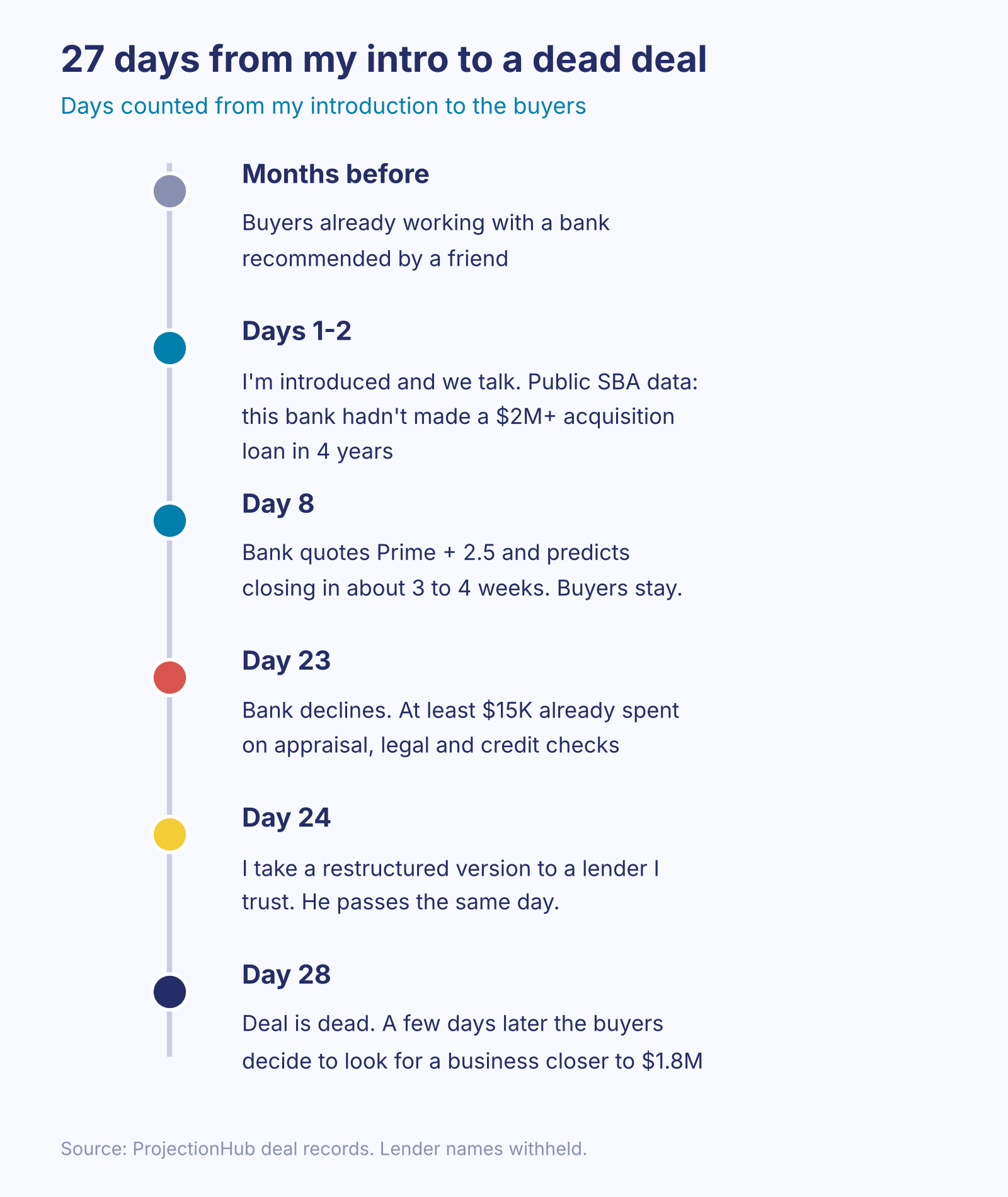
On our first call they told me about their lender. A quick look at public SBA loan data showed this bank had not made an SBA acquisition loan over $2 million in the last four years.
I told the buyers the lender might be a really nice guy, but there was a real concern, because his bank simply doesn't make loans like this. A week later they told me the bank had quoted Prime + 2.5. I told them that was the high end of what I see and offered to shop their package to other lenders. They felt they were too far down the path with this lender, so they kept going.
About three weeks after our first call, the bank declined the loan at what seemed like the last minute. The buyers thought they were at the 1-yard line. They already had at least $15,000 in the deal for an appraisal, purchase agreement legal work and credit checks.

Their loan package had 50+ documents, including a credit memo, business plan, projections and valuation. Only two numbers mattered, and their lender should have known both from the very first conversation.
The debt service coverage ratio on the proposed loan was 1.24. That is right on the razor's edge of what a lender is going to be comfortable with; it typically needs to be 1.25 or above. When a deal barely cash flows, the mitigating factor needs to be a really strong borrower.
Unfortunately, the buyers needed to put about $170,000 of equity into the deal under the proposed structure, and the partners had about $175,000 in cash to their names. That is roughly 5% down with nothing left over. Cash flow was as tight as it can be, and so was liquidity. If anything went wrong after closing, the deal blows up. You can't get a $3 million deal done like that.
I still tried to find a lender. The day after the decline, I took the package to a lender I trust with a proposed restructure: bring the price just under $3 million, ask the seller to leave $100,000 to $150,000 of cash in the business, and use a larger seller note on full standby to lift the coverage ratio off the edge. He passed the same day. Liquidity and borrower strength were the main issues, along with other borrower issues and items in the purchase agreement SBA won't finance. Other lenders gave me similar feedback.
I really think this deal was only doable with a big restructuring, because there was no post-closing liquidity. You're not going to find a lender willing to do a very large acquisition loan with very little collateral, only about 5% down and nothing left in the bank after closing.
The deal died about four weeks after I met the buyers. A few days later they told me they would keep hunting, this time for a business closer to $1.8 million.
Was the lender lying when he said he could get this deal done? Not intentionally. The loan officer really tried hard. His bank hadn't made a loan this large in four years, so this was very likely the biggest deal he had ever worked on, and he had every motivation to get it done. He just didn't know what he didn't know. He didn't realize that on a loan that size, zero post-closing liquidity is not going to fly. In the end, his clients lost time and money, and probably the deal.
If you haven't done serious research on your SBA lender, let me look up their SBA loan history for you. I'll check that they have experience with your type of deal and that they charge fair, market rates.

Adam will review your deal before you talk to lenders and tell you honestly what lenders will flag. No cost.
Get a free SBA review