
11/7/2026 by Adam Hoeksema
Adam Hoeksema
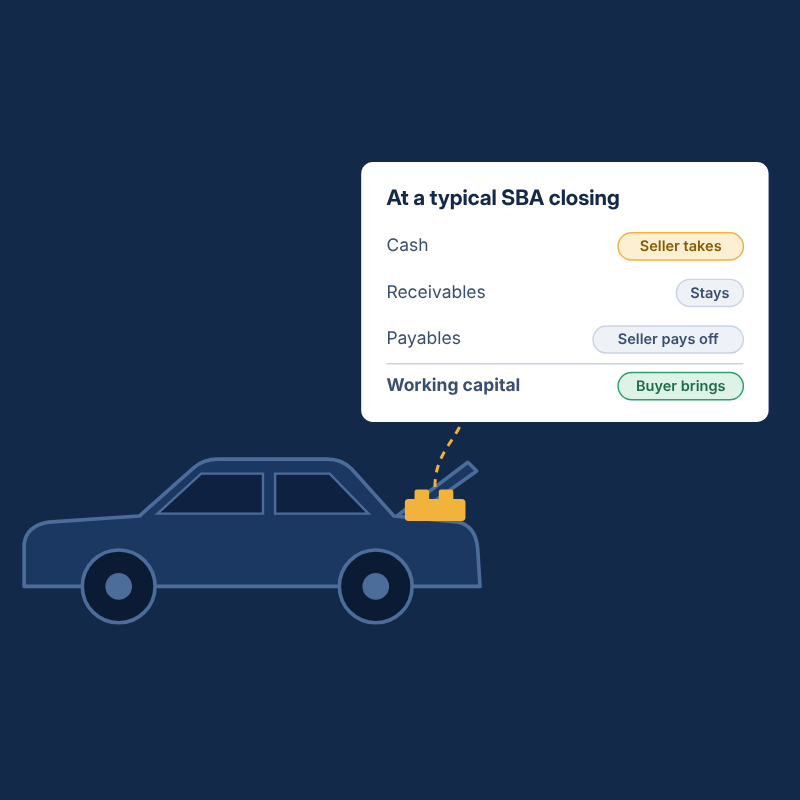
In most SBA acquisitions, the seller does not leave working capital in the business unless it is specifically negotiated. The seller usually takes the cash, and the buyer is expected to bring the working capital needed to run the business after closing. That said, there is no single right answer. Every deal I see seems to handle this a little differently, and it is always negotiable.
This question comes up on almost every acquisition I work on, and it causes more surprises than it should. A buyer often assumes the seller will leave enough cash, receivables and inventory in the business to keep it running. The seller, meanwhile, has never even considered that. Remember that most sellers have never sold a business before. They have no reason to know what a buyer might expect.
In this post I will walk through what is normal in an SBA deal, why it can catch both sides off guard, and how to make sure working capital doesn't sink your deal after closing.
What usually happens at closing in an SBA deal
The most common scenario I see looks like this:
- Cash: The seller takes it.
- Accounts receivable: Left in the business for the buyer.
- Accounts payable: Paid off by the seller at closing out of the sale proceeds.
- Working capital going forward: The buyer brings it, either from their own cash or as part of the SBA loan.
The general expectation from sellers is that the buyer is responsible for funding working capital. In smaller deals that don't need much working capital, that works just fine. The problems start when the business needs a meaningful amount of cash to operate and nobody talks about it until late in the process.
Why sellers are often surprised at closing
I have seen plenty of deals where the seller has a number in their head. Say they want to sell the business for $2 million, so they expect to receive $2 million at closing. Then the buyer asks them to leave $150,000 of cash in the business for working capital. The buyer may also want the seller to finance part of the deal with a seller note. After the business broker takes their commission and the tax man takes his cut, the cash the seller actually puts in their pocket is surprisingly less than they expected.
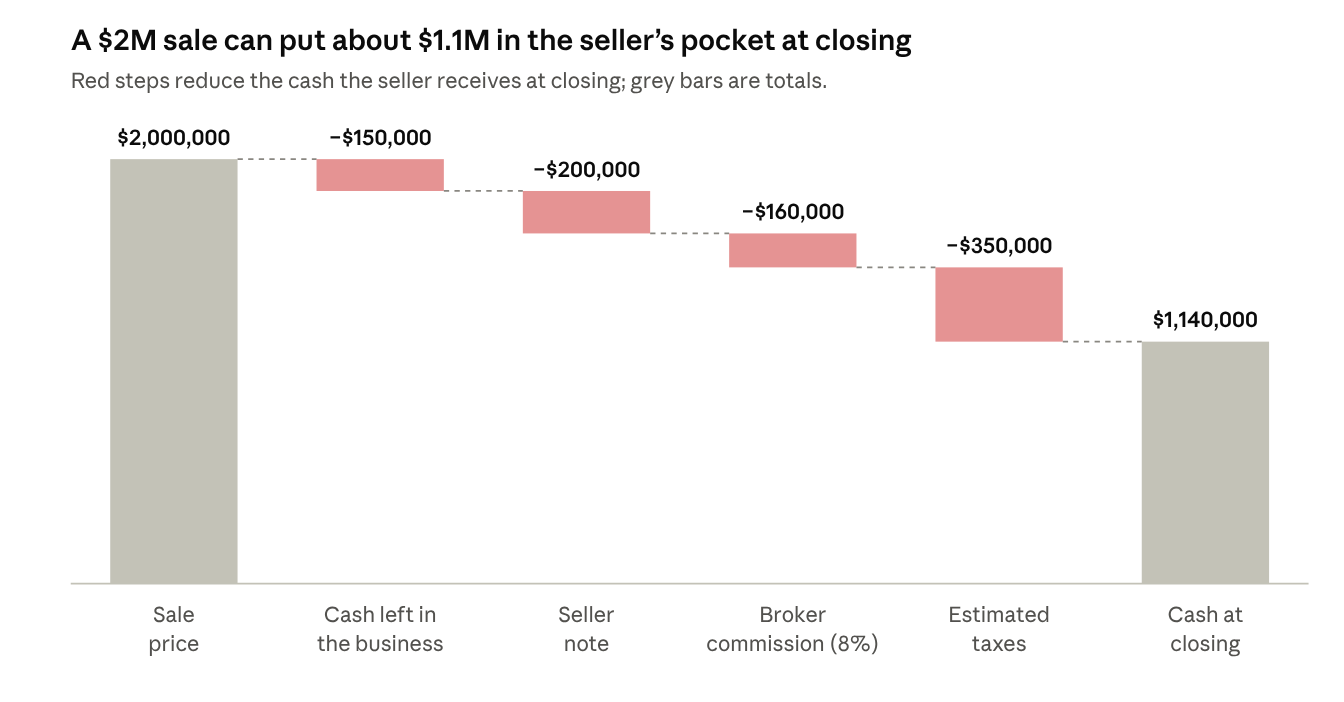
The seller note isn't lost, since it gets paid back over time, but it isn't cash at closing. Taxes will vary a lot from deal to deal, so sellers should run their own numbers with their CPA. The point is that working capital is one of several things standing between the headline price and the check the seller takes home, and it should be discussed right alongside the others.
The car engine argument
The most common misconception I hear from buyers is that it's simply assumed the seller will leave a normal amount of working capital in the business. The cash, the inventory and the accounts receivable are all part of the engine that makes the business run. So the buyer says, “I expect you not to take the engine out of the business. You wouldn't sell a car without the engine.”
I think there is good logic to that. But you have to remember the other side of the table. Most sellers have never sold a business before, so they may have no idea they should expect to leave working capital behind. And depending on the type of business, that working capital amount can be quite material to the overall transaction.
My advice is simple: clarify working capital with the seller early. Put it in the LOI. If it first comes up a few weeks before closing, it feels to the seller like you are trying to retrade the price, even if your request is perfectly reasonable.
When sellers do leave working capital
It is common for sellers to agree to leave some amount of working capital in the bank, especially when the timing of the sale makes the need obvious.
A good example is a very seasonal lawn care business I worked with. A lawn care company builds up a lot of cash by the end of the season, and that cash has to carry the business through the winter until spring. This acquisition was closing right at the end of the busy season.
The seller sat down and calculated the fixed costs to keep the business open until spring. It came to roughly $10,000 per month for 5 months, so the seller left $50,000 in the bank at closing. It was easy to agree on because the number was based on real costs and both sides could see why it was needed.
Why the working capital math gets complicated
How much working capital a buyer should borrow or bring depends on the specific business, and it can get exceedingly complicated. The timing of your closing date alone can change the answer by hundreds of thousands of dollars.
Here is a hypothetical example. Picture a manufacturer of outdoor products that sells to retailers. It buys materials and builds inventory from January through April. It ships to retailers from March through June. The retailers pay on 90-day terms, so the cash doesn't come in until July through September. At the peak, the business has about $820,000 tied up in inventory and receivables, net of what it owes suppliers.
Assume the deal follows the typical SBA pattern: the seller takes the cash and pays off the payables, and the buyer gets the inventory and receivables. Here is how much cash the buyer would need to bring, depending on the month the deal closes.
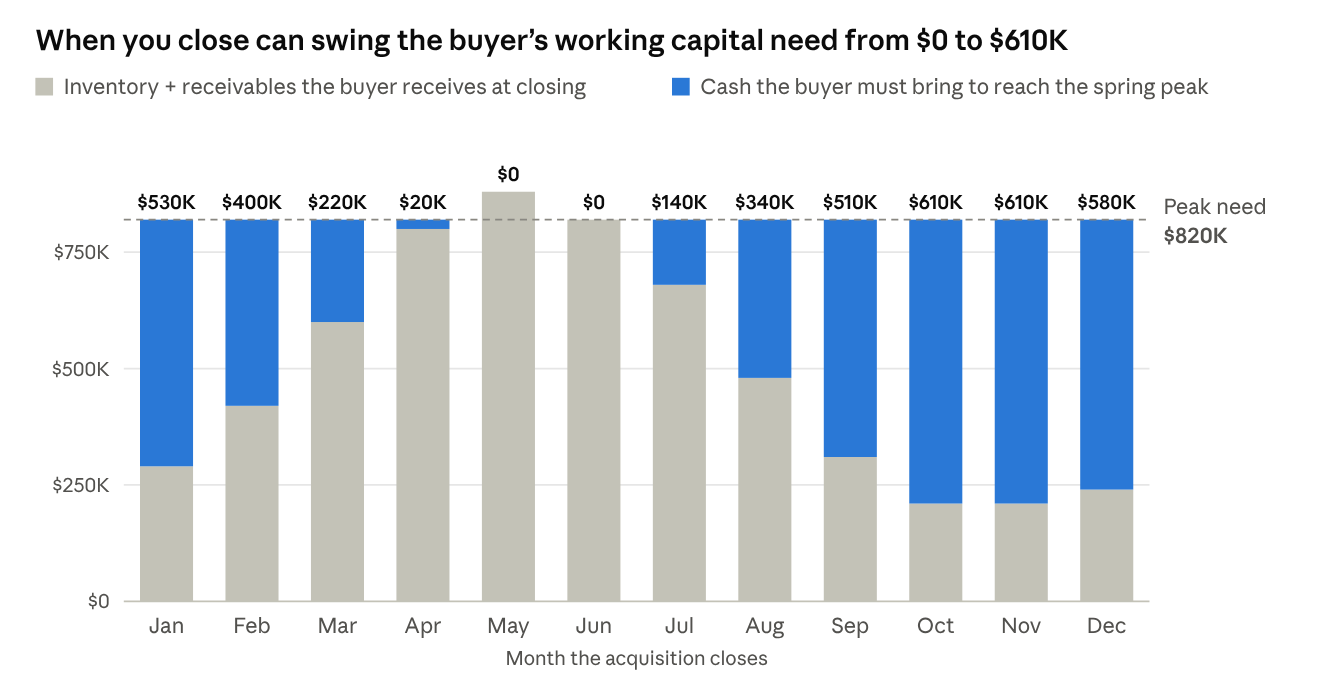
Close in October and the buyer receives only about $210,000 of inventory and receivables. They then have to fund the entire inventory build and wait for retailers to pay, which means bringing roughly $610,000. Close in May and the buyer receives about $880,000 of inventory and receivables that turn into cash over the summer, so they may need almost nothing. Of course, that also means the seller is leaving a lot in the business, and they will want to be paid for it.
This is why buyers need to be really careful in these situations. A few lessons:
- Build a month-by-month cash flow projection that starts on your actual closing date. An annual average will hide the problem.
- Watch out for a slipping closing date. In this example, an April closing that slips to July raises the buyer's need from about $20,000 to $140,000. SBA deals slip all the time.
- Match the financing to the swing. A business like this needs a line of credit that can expand and contract with the season, not just one lump sum of working capital on day one.
What happens if you ignore working capital
I have seen a deal where the buyer simply didn't have enough working capital in the initial structure. Honestly, the SBA lender should have known better and built it into the loan. But they were inexperienced and did not.
Just 2 months after closing, the buyer missed their first SBA loan payment and needed an emergency injection of cash to stay open and make payroll. The bank didn't want to help. The buyer ultimately had to bring on an equity investor and give up a significant piece of the business, because emergency money is the most expensive money there is.
That is the one thing you can't do in an acquisition. You can negotiate working capital a dozen different ways, but you cannot ignore it. If you do, you could be the buyer missing a loan payment in month 2.
How SBA lenders handle working capital
Not every SBA lender handles working capital the same way, and that matters more than most buyers realize.
Some lenders really only want to do a 7(a) term loan that includes some permanent working capital. They may not offer a line of credit, because lines are harder for the lender to manage and monitor. Non-bank SBA lenders in particular are the most likely to skip lines of credit.
For a business with modest, steady working capital needs, a slice of permanent working capital in the term loan can be enough. But if you are buying a working-capital-heavy business, you really need a lender who can offer a line of credit. Trying to solve a swinging working capital need with a fixed lump of cash on day one usually means you borrowed too much in some months and not enough in others.
Should you use a working capital peg in an SBA deal?
Buyers coming from the private equity or middle-market world often expect a working capital peg. A peg sets a target level of working capital the seller must deliver at closing, then trues it up 90 days or more after close. If the business was delivered with less than the target, the seller owes the difference. If it had more, the buyer pays the seller.
I think a peg is necessary on some deals. In SBA deals I mostly see them on larger acquisitions and on businesses with complex working capital, such as:
- Construction companies with substantial work in progress on long-term projects
- Manufacturers carrying significant inventory and long customer payment terms
- Highly seasonal businesses where working capital swings dramatically during the year
But a peg adds real complexity. Your seller may not understand it, and a payment that gets calculated months after closing can feel to them like you are setting up a way to take advantage of them. It also creates plenty of opportunities for disputes later if the terms aren't crystal clear up front. I typically suggest avoiding a peg if you can. If you can't, make sure your attorney spells it out really, really clearly.
What clear peg language looks like
Here is an illustrative example of the kind of detail you want in the purchase agreement. This is not legal advice, and your attorney should draft the actual language for your deal.
Target Net Working Capital. “Target Net Working Capital” means $400,000, which equals the average of the Business's month-end Net Working Capital for the 12 full calendar months before the Closing Date, as calculated on Schedule 2.4.
Net Working Capital. “Net Working Capital” means (a) accounts receivable net of the allowance for doubtful accounts, inventory valued at the lower of cost or net realizable value, and prepaid expenses, minus (b) accounts payable and accrued expenses. It excludes cash, income taxes, indebtedness, and transaction expenses. It is calculated using the same accounting methods, policies and practices used in the Business's financial statements for the 12 months before Closing, as illustrated on Schedule 2.4.
Adjustment Escrow. At Closing, $50,000 of the Purchase Price will be deposited with the Escrow Agent (the “Adjustment Escrow”).
Closing Statement. Within 90 days after Closing, Buyer will deliver to Seller a statement of Net Working Capital as of the Closing Date, with reasonable supporting detail. Seller has 30 days to review it, with reasonable access to the Business's books and records, and may deliver a written notice of disagreement that identifies each disputed item and amount.
Disputes. Buyer and Seller will negotiate in good faith for 15 days to resolve any disputed items. Unresolved items will be submitted to an Independent Accountant, who will decide only the disputed items, within the range of the parties' positions. The Independent Accountant's decision is final and binding. Its fees are split in proportion to how far each party's position was from the final result.
Adjustment. No adjustment is made if final Net Working Capital is within $10,000 of Target. If final Net Working Capital is below Target by more than $10,000, Buyer will receive the full shortfall, first from the Adjustment Escrow and then directly from Seller within 10 business days. If it exceeds Target by more than $10,000, Buyer will pay Seller the full excess within 10 business days.
Release. Within 5 business days after the final determination, the Escrow Agent will release any remaining balance of the Adjustment Escrow to Seller.
Notice how much is pinned down: how the target was calculated, exactly which accounts count, which accounting methods apply, who prepares the statement, how long each side has, who breaks a tie, and where the money comes from.
How escrow helps during the true-up period
Escrow protects both sides during the months before the final number is known. The buyer knows money is set aside to cover a shortfall without having to chase the seller. The seller knows the funds can only be used for the true-up under clear rules, and that any unused balance comes back to them. Size the escrow to a realistic swing in working capital, not the entire target. Too small and it doesn't protect the buyer, and too large and it ties up a lot of the seller's proceeds.
The bottom line
In a typical SBA acquisition, the seller takes the cash, leaves the receivables, pays off the payables, and expects the buyer to bring working capital. Sellers agree to leave working capital behind more often than you might think, but only when someone raises it early and backs it up with real numbers.
There is no one right way to handle this. Every deal is different, and it is all negotiable. The only wrong answer is ignoring it.
If you have a deal that looks like it will require a lot of working capital and you are trying to figure out what to offer, or how to structure your offer with the seller in a way that is bankable, feel free to reach out to me at adam@projectionhub.com.


