
11/6/2026 by Adam Hoeksema
Adam Hoeksema
If you own multiple locations of a business and want to sell one of them, or you're the buyer trying to get an SBA loan to buy that one location, there's a problem you're probably going to run into.
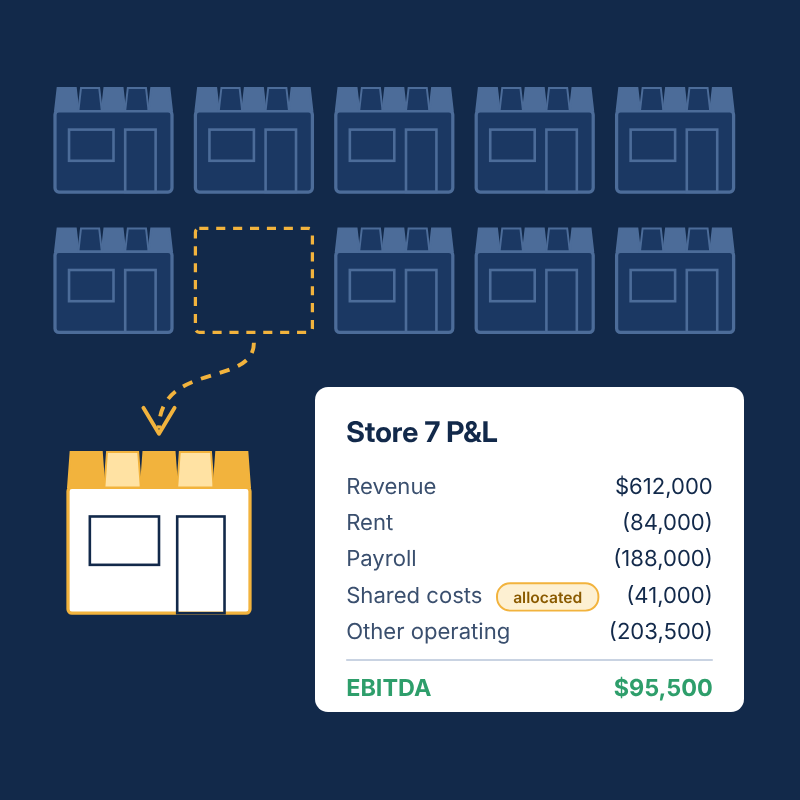
I've seen it several times with UPS Store deals. Let's say an owner has 10 UPS Stores. All 10 stores are under one company and file one tax return. A buyer comes along who wants to buy just one of those stores, and they're going to use an SBA 7(a) loan to do it. The lender asks for the financials for that one store for the last three years.
The problem is they don't exist. The tax return has all 10 stores lumped together. The seller can pull the sales for that store out of the point-of-sale system, but sales don't cover loan payments. Cash flow does.
In this article I'll walk through what the SBA SOP actually says about buying part of a business, why sales reports usually won't get the job done, and why a CPA compilation for the individual store is often the answer.
What does the SBA SOP say?
The current SBA SOP is 50 10 8.1, effective October 1, 2026. Normally, when a business is being sold, the SBA lender has to verify the seller's financial info against what the seller filed with the IRS.
But the SOP has a specific exception for when you're buying a division or a segment of a business. Here's the exact language from Section A, Chapter 5:
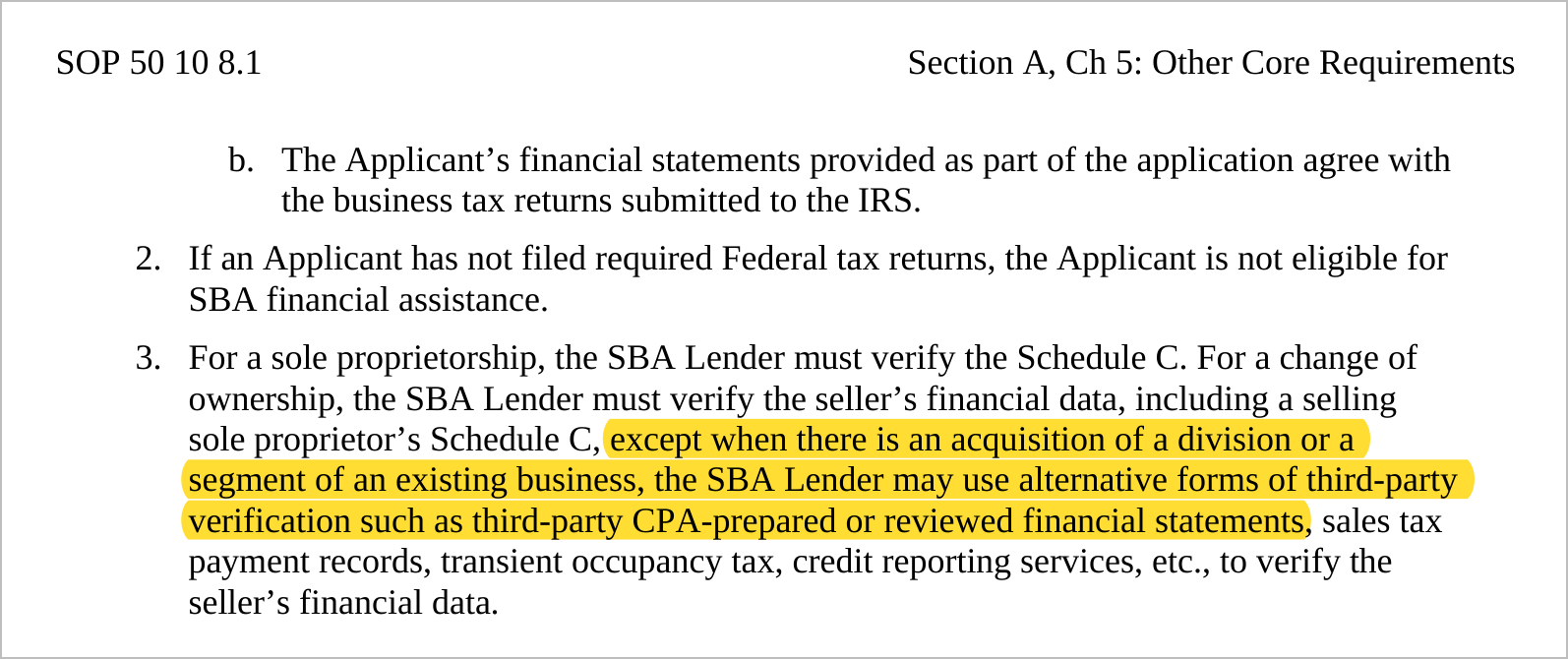
So the SBA understands that a tax return for 10 stores can't verify the numbers for 1 store. They give lenders some other options, and the first one on the list is CPA-prepared or reviewed financial statements. You'll notice sales tax records are on that list too. I'll get to why I don't think those are enough in a minute.
Lenders need cash flow, not just sales
Verifying the seller's numbers is one thing. But the lender also has to show that the business can actually repay the loan. Appendix 15 of the SOP, which covers changes of ownership, spells out what the lender's analysis has to be based on:
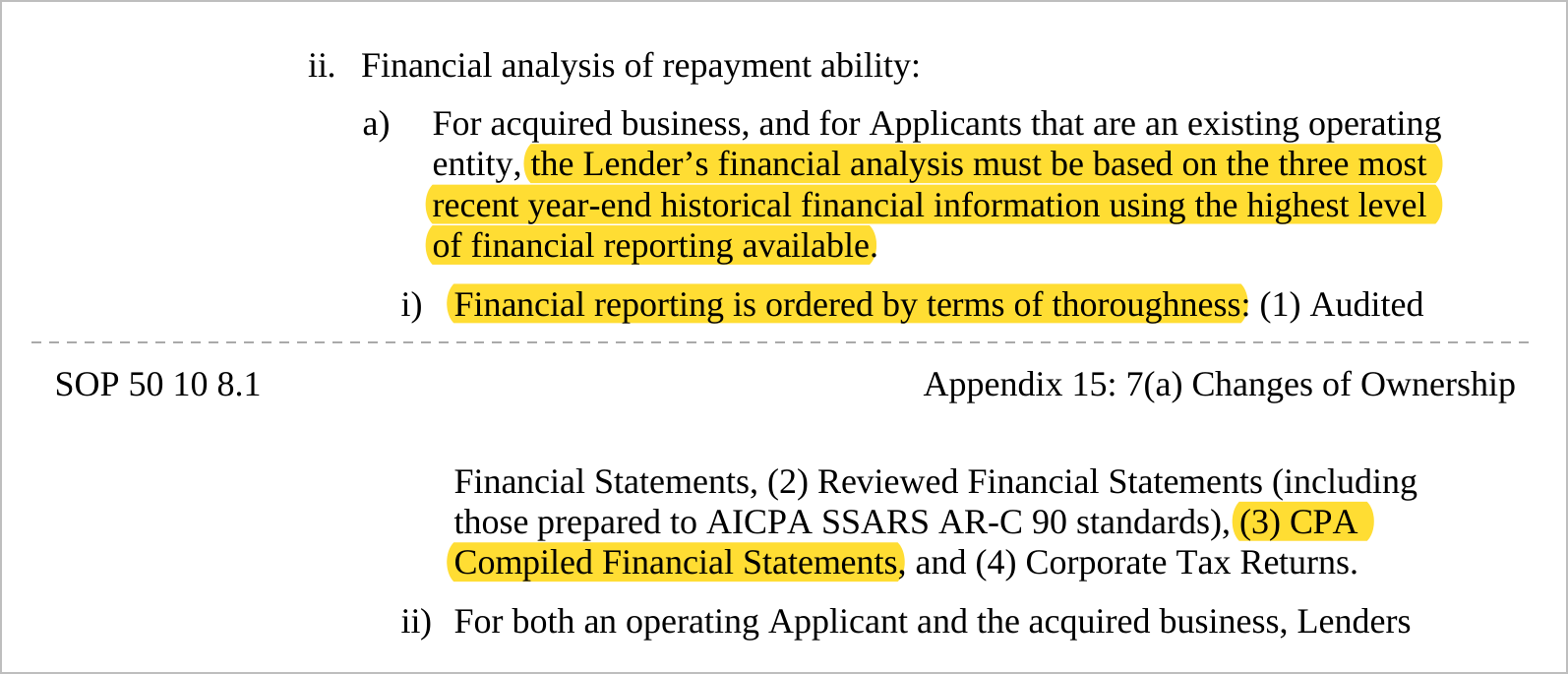
A few things jump out here:
- The lender needs three years of historical financials, using the highest level of financial reporting available.
- CPA compiled financial statements rank above tax returns on SBA's list.
- The lender also has to look at year-to-date numbers compared to the same period last year.
- For an initial acquisition, cash flow has to cover the new loan payments at least 1.25 times. SBA measures that using EBITDA, which means you need expenses, not just revenue.
That last one is where selling a single store gets stuck. You can't calculate EBITDA from a sales report. And if all 10 stores are on one tax return, there isn't any level of financial reporting for that one store. A CPA compilation creates it.
In practice, the lender is going to want a P&L for the store for each of the last three years, plus a year-to-date P&L. They usually don't care as much about a balance sheet for the store, because in most of these deals the buyer isn't taking on any of the seller's debt. The assumption is that the balance sheet will be clean at closing.
Why POS reports and sales tax records aren't enough
When a lender asks for store-level financials, sellers and brokers usually grab whatever is easiest to pull. Here's how those typically stack up:
In my experience, if you hand an SBA lender only POS reports or franchisor sales reports for a deal like this, they're most likely going to decline. It's not that they don't believe the sales. It's that sales reports don't tell them anything about expenses, so they can't tell whether there's enough cash flow to cover the loan payment. Sales do not cover loan payments, cash flow does.
The seller-prepared P&L is the tricky one, because it looks like it solves the problem. In one UPS Store deal I worked on, the seller gave us a QuickBooks P&L for the store being sold. When we compared it to the tax return, some things didn't add up. It looked like they had allocated all of the general manager's salary to the other stores and none of it to the store being sold. That overstated the profit of the store being sold, and that's exactly why the SBA lender wanted CPA compiled financials.
The hard part is allocating shared costs
Pulling sales for one store is easy. The real work is figuring out how much of the shared costs belong to the store being sold.
I worked with a client who was buying 2 stores from a seller who owned 17. The seller was big enough that they had:
- A CFO, whose salary should be spread across all 17 stores
- A staff accountant, also shared across all the stores
- Two district managers, with the more experienced manager covering 10 stores and the other covering 7
The 2 stores being sold came out of the group of 10. So how do you allocate the district manager cost? Do you take 2/10ths of that one manager's comp? Or do you add both district managers' comp together and take 2/17ths of the total? You could make a case either way. What matters is that the seller has a reasonable basis for it and can back it up with something like payroll records, leases, or how the managers actually spend their time.
This matters more than you might think. With UPS Stores, the sales prices really require every reasonable add-back to cash flow just to make the SBA loan work. An extra $10,000 one way or the other based on an allocation can be the difference between the loan working or not.
What a CPA compilation is (and what it isn't)
A compilation is the most basic level of financial statement work a CPA firm does. Here's how it compares to a review and an audit:
Here's what's a bit ironic about the SBA accepting CPA compilations. A compilation provides no assurance that the financials are correct. In theory, a CPA could take the seller's P&L, put it into a standard format, put it on their letterhead, and be done.
That's not how we approach it. The compilations we arrange are performed by an independent, licensed CPA firm with experience in SBA lending and acquisitions. The seller is responsible for the financial statements, including how shared costs are allocated. But from years of working with SBA lenders, buyers, and sellers, we know what a lender is going to be looking for. During the engagement, the CPA asks how each allocation was determined and what records support it. Those questions usually help sellers tighten up their documentation before a lender ever sees it.
The CPA also uses common sense. If the tax return shows all the stores spending 5% of revenue on advertising, but the store being sold shows 1%, that's something that gets raised with the seller.
When should a seller get started?
If you're pretty certain you're going to sell the location, you can get the last three years compiled before you even list it. Then once you're under LOI, you finish the year-to-date compilation so the lender has the most up-to-date numbers. The engagement can be priced once for the three years plus year-to-date, with the year-to-date piece finalized when you're close to closing.
We started helping with this because we kept running into the same problem over and over. Sellers had a hard time finding a CPA who was willing to do a compilation at all, and when they did, the fees were extremely high.
Then there's tax season. If you need a compilation in February, good luck. You'll probably need to wait until after the April 15 deadline, then until after your CPA goes on vacation, then until after they catch up on everything they set aside during tax season. If you ask in January or February, you might be lucky to get it done in June. Your buyer won't wait that long.
We work with CPAs whose schedules aren't tied to tax season, so compilations can be done year-round, often in about a week once the seller provides everything that's needed.
This isn't just a UPS Store issue
I've used UPS Stores as the example because that's where I've seen it the most. But the same thing happens any time someone wants to buy part of a business that files as one entity:
- Multi-unit franchises of any brand where the owner's locations share one tax return
- Franchise territories that get split. I've seen franchises take a state and split it into north and south territories, with shared expenses that need to be allocated between them.
- One location of a multi-location business, like a restaurant group
- A division or product line being carved out of a larger company
Sales reports, leases, and payroll reports can all help defend the allocations. But you still need to do the work to build the financials on a basis you can back up.
Frequently asked questions
Does the SBA require a CPA compilation to buy one location of a business?
Not in those exact words. The SOP lets lenders use alternatives like CPA-prepared financial statements or sales tax records to verify a division or segment. But the lender still needs three years of financials for that location to figure out cash flow, and a compilation is usually the only way to get there.
Can't the seller just put together a P&L for the store in QuickBooks?
They can, and it's a good place to start. But lenders know seller-prepared allocations can overstate profit, like the general manager example above. A compilation puts the statements in a standard format, and SBA ranks it above tax returns.
How many years of financials does the lender need?
Typically the last three years, plus year-to-date and the same period from the prior year.
Is a compilation the same as an audit?
No. An audit tests and verifies the numbers. A compilation doesn't provide any assurance.
Who pays for the compilation?
Usually the seller, since it's documenting the business they're selling.
Selling or buying one location?
If you're a seller, buyer, or broker working on a deal like this, shoot us an email at support@projectionhub.com and we can talk through what the lender is going to need.
Compilations of financial statements are performed and issued by an independent, licensed CPA firm. ProjectionHub is partnered with a licensed CPA firm to perform or issue compilation reports.


